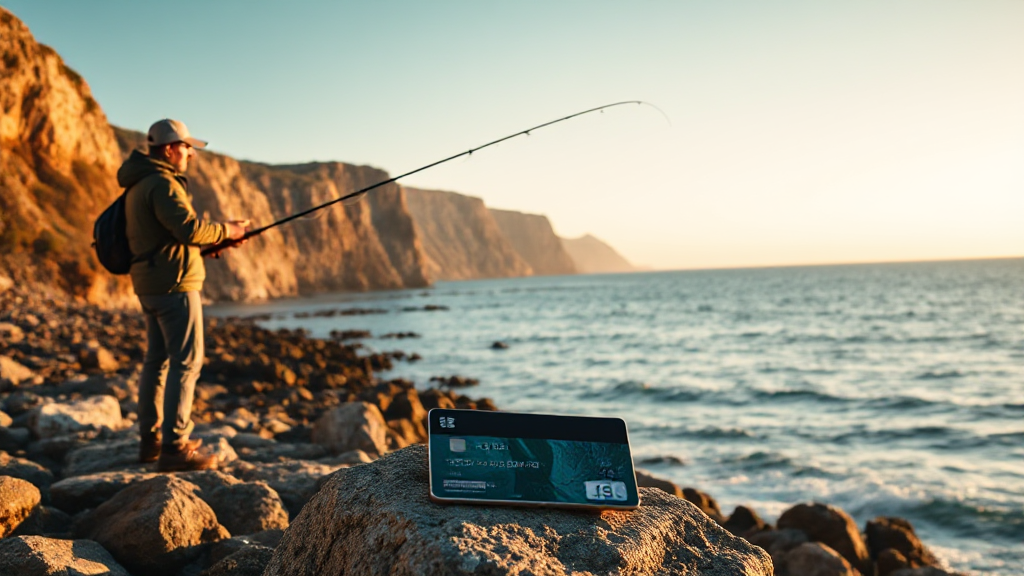
Fishing in Portugal Not Working? Fix the Licence Problem First
Fishing in Portugal Not Working? Fix the Licence Problem First
So you have already tried to sort out fishing in portugal and something went wrong. Maybe the government portal refused your details, maybe you could not find the right category, maybe you gave up halfway through a form that seemed designed for someone who already knew the answers. That is a common experience, and it is almost never about you being bad at paperwork. It is about approaching the requirement in the wrong order.
This is written the way I would explain it to a friend who texted me from a car park near a Portuguese harbour, rod already assembled, wondering why the online process kept failing. The fix is not complicated. You just need to get the requirements straight before you open any application, then follow a short procedure, then check a few specific things that cause most of the failures.
What You Actually Need Before You Start Any Application
The single biggest reason people get stuck is that they begin the application before they have gathered the inputs. Then the form times out, or they cannot answer a mandatory field, and they assume the system is broken. It is not. It is waiting for information you have not prepared yet.
Here is what should be sitting in front of you before you touch anything.
Your identity document. For most visitors this is a passport. For residents it may be a residence document or national ID. The name must match exactly, including middle names and any accents, because a mismatch between the name on your document and the name on the licence is one of the classic reasons a licence gets questioned later. If your passport shows “Maria da Silva” and you type “Maria Silva”, fix it. Do not assume it will be fine.
Your dates. You need the exact start date you want the licence to begin and the exact end date. If you are fishing for a week, decide whether you want a short period or something longer. Do not guess. Write the dates down.
Your location or region. Recreational sea fishing in mainland Portugal is administered at a national level through DGRM, but you should still be clear about where you intend to fish. Are you fishing from the shore, from a boat, from a rocky point, from a beach? Are you in the Algarve, the Lisbon coast, the Silver Coast, the Alentejo coast, or further north? This matters because it shapes which category applies to you and what rules sit on top of the licence.
Your payment method. A card that works for international online payments, or a phone with Apple Pay or Google Pay configured. A card that only works domestically, or a card that triggers a bank security block on foreign transactions, will stop you dead at the final step. If you have had trouble with online payments before, use a different card or use Apple Pay or Google Pay instead.
A stable connection and ten quiet minutes. Not a train. Not a beach with one bar of signal. Not a shared computer in a hostel lobby where someone else might close the browser. The application itself is short, but it needs to complete without interruption.
If you have all five of those ready, most of the problems people describe simply do not occur. If you are missing any of them, that is almost certainly where your earlier attempt fell over.
Why the Official Route Fails for So Many Visitors
The official Portuguese system is not designed to be hostile. It is designed for people who already understand Portuguese administrative categories. That is the gap.
The first issue is terminology. The categories do not map cleanly onto the way an English-speaking angler thinks about fishing. You may be asked to choose between shore fishing, boat fishing, spearfishing, or other classifications, and the descriptions are not always obvious. Pick the wrong one and you may end up with a licence that does not actually cover what you plan to do.
The second issue is identification. Some processes assume you have a Portuguese tax number, known as a NIF. If you are a tourist, you probably do not. If the form asks for one and you do not have one, you may conclude the whole thing is impossible. It is not, but you need a route that does not depend on a NIF.
The third issue is language. Machine translation on a government form is unreliable. A field labelled one way in Portuguese can be translated into something misleading in English, and you end up entering data in the wrong box.
The fourth issue is payment. International cards are sometimes declined by the payment processor even when the card is perfectly valid. This is not a sign that your card is bad. It is a sign that the payment path is not built for cross-border users.
The fifth issue is simply confidence. When a form feels unfamiliar and important, people hesitate, second-guess themselves, and abandon it. Then they go fishing anyway, which is the actual risk, because fishing without the correct licence in Portugal can lead to fines and having your gear inspected and potentially seized.
This is exactly the gap that a fishing license application service is built to close. Instead of wrestling with a system designed for locals, you answer a short set of plain questions and the application is handled for you. The process is designed to take around three minutes, does not require a NIF, and does not require you to navigate the government portal yourself. Payment is by card, Apple Pay, or Google Pay, which removes the international card problem in most cases.
That is not a shortcut around the rules. It is a shortcut around the friction. The licence itself is the same licence, issued through the proper channel. You are just not doing the data entry in a language and format you do not understand.
The Procedure That Actually Works, Start to Finish
Here is the sequence. Follow it in order and you will not hit the usual walls.
Step one: confirm which licence category you need. Decide whether you are fishing from shore, from a boat, or something else. If you are unsure, think about the actual activity you will be doing, not the label. Standing on rocks with a rod is shore fishing. Sitting on a charter boat is boat fishing. Diving with a speargun is its own category. Get this right before anything else, because everything downstream depends on it.
Step two: decide your dates. Choose the start date and the duration. If your trip is fixed, use the trip dates. If you live in Portugal and fish regularly, choose a longer period so you are not reapplying constantly. Write the dates down so you can enter them consistently.
Step three: prepare your identity details. Full name as it appears on your document, date of birth, document number, nationality. Check the spelling twice. Accents matter. Hyphens matter. If your document says “O’Brien”, do not type “OBrien”.
Step four: start the application through a service that handles the DGRM process for you. You will be asked a short series of questions. Answer them plainly. Do not overthink. Do not try to be clever about your category. If you are genuinely unsure, pick the option that matches the activity you described in step one.
Step five: pay. Use a card that works internationally, or use Apple Pay or Google Pay. If your first payment attempt fails, do not immediately assume fraud. Try a different method. Many failures are method-specific rather than account-specific.
Step six: wait for confirmation and keep the licence accessible. Save it to your phone. Save a copy to your email. If you are fishing in a group, make sure every adult who is fishing has their own licence, because a licence is personal and does not cover the person next to you.
That is the whole thing. Six steps. The reason people fail is almost always that they skip step one or step three, then get stuck at step four and blame the system.
What to Check When Your First Attempt Did Not Go Through
Now the troubleshooting. If you already tried and it failed, work through this list. One of these is almost certainly your problem.
The name mismatch. Compare your document and your application character by character. Missing middle name, dropped accent, wrong order of surnames, a hyphen turned into a space. Any of these can cause a rejection or a licence that does not match your ID. Fix it and reapply.
The wrong category. If you selected boat fishing but you are fishing from shore, or vice versa, the licence may be valid but not for your activity. This is the kind of thing that only becomes a problem when you are inspected. Go back and check what you actually selected.
The NIF assumption. If you abandoned the process because it asked for a Portuguese tax number you do not have, that is a solvable problem. You do not need a NIF to get a recreational sea fishing licence for mainland Portugal through a proper application service. Restart with that in mind.
The payment decline. If your card was declined, try Apple Pay or Google Pay, or a different card. If your bank sent you a security message, approve it and retry. If the decline was silent, contact your bank and ask whether they blocked an international online transaction. This is extremely common and has nothing to do with the licence itself.
The session timeout. If you started the form, walked away, and came back to an error, the session probably expired. Start again with everything ready. Do not try to resume a dead session.
The browser problem. Old browsers, aggressive privacy extensions, and corporate networks can all break form submission. Use a current browser, disable anything that blocks scripts on the application page, and avoid public Wi-Fi if you can.
The duplicate application. If you submitted twice because you were not sure the first one worked, you may now have two records or an error. Check your email including spam before submitting again. If you already paid twice, contact the service you used rather than starting a third application.
The email problem. If you never received confirmation, check spam, promotions, and any filtered folders. Search for the service name. If it is genuinely not there, it may have gone to an address you mistyped. This is another reason to slow down on the identity step.
Work through these in order. Most people find their answer in the first three.
Rules That Catch Visitors Out Once the Licence Is Sorted
Getting the licence is the gate. Passing through it does not mean anything goes. There are rules that apply on top, and they vary by area and by activity.
Size and bag limits. Portugal sets minimum sizes and daily limits for many species. These are not suggestions. If you keep undersized fish, you can be fined. Learn the limits for the species you are likely to catch in the area you are fishing. If you do not know a species, release it.
Protected species. Some species are fully protected and must be released immediately, carefully, and without being lifted out of the water if possible. If you are unsure what you have caught, photograph it, release it, and look it up later.
Protected zones. Some stretches of coast, estuaries, and marine reserves are closed to fishing or have specific restrictions. A general licence does not override a local closure. Check before you cast, especially if you are fishing near a reserve or a busy swimming area.
Gear restrictions. There are limits on the number of rods, hooks, and lines a single angler may use. There are also restrictions on certain methods in certain areas. If you are used to fishing somewhere with looser rules, do not assume your normal setup is fine.
Night fishing. Some locations restrict or prohibit fishing after dark. If you plan to fish at night, confirm it is allowed where you are going.
Access rules. Cliffs, dunes, and protected habitats often have access restrictions that have nothing to do with fishing licences. Do not park in a no-parking zone, do not trample vegetation, and do not cross fences to reach a mark. Local authorities enforce these, and anglers who ignore them create problems for everyone.
Boat-specific rules. If you are fishing from a boat, there may be additional requirements depending on the vessel, the distance from shore, and whether you are with a licensed skipper. If you are on a charter, ask the skipper what is covered and what you still need personally. A boat licence does not automatically cover every passenger.
The theme here is that portugal fishing rewards preparation. The people who have a bad experience are usually the ones who treated the licence as the only requirement and ignored everything that sits on top of it.
Choosing Where to Fish So the Trip Actually Works
Portugal has an enormous variety of coastline, and the experience changes dramatically depending on where you go. This is not just about scenery. It affects what you catch, what gear you need, and how safe the mark is.
The Algarve. Warm water, dramatic cliffs, and a long season. Good for shore fishing from rocks and beaches, and popular for boat trips. It is also the most crowded in summer, so access and parking can be a problem. If you are fishing from rocks, check the swell before you commit. The Algarve looks calm from the road and behaves differently at the waterline.
The Lisbon coast. A mix of beaches, estuaries, and rocky points. The Tagus estuary is productive but has its own rules and can be busy with other water users. Good for anglers who want variety within a short drive.
The Silver Coast. Bigger swell, more exposed, and often better for surf fishing. It is less forgiving than the Algarve. If you are new to shore fishing in Portugal, this is not the place to learn about wave safety.
The Alentejo coast. Wild, sparsely populated, and beautiful. Fewer facilities, fewer other anglers, and more space. Bring everything you need, because there may be nowhere nearby to buy it.
The north. Cooler water, rugged coast, and a different species mix. Good for anglers who want to get away from the tourist trail.
Wherever you go, the same three local checks apply. First, is fishing allowed here at all? Second, what is the swell and wind doing? Third, where does the water go when the tide turns, because being cut off on a rock is a real and common accident. Ask locally if you are unsure. Portuguese anglers are generally happy to help if you approach them respectfully.
Fixing the Problem Comes Down to Order and Detail
If your earlier attempt at fishing in Portugal did not work, the cause was almost certainly not the sea, the fish, or your ability. It was the order in which you did things and the precision of the details you entered.
Get your identity document, your dates, your category, and your payment method ready before you start. Use a service that handles the DGRM application for you so you are not fighting a form in a language and format built for someone else. Pay with a method that works across borders. Save the confirmation where you can find it on the water.
Then, once the licence is in hand, do the checks that actually keep you out of trouble. Know your size and bag limits. Respect protected zones and access rules. Watch the swell. Know when the tide turns. Carry your licence on your phone and make sure everyone fishing with you has their own.
That is the whole fix. It is not dramatic and it does not require special knowledge. It requires you to stop treating the licence as an obstacle to get past and start treating it as the first step of a trip you have planned properly. Do that, and the next time you are standing on a Portuguese shore with a rod in your hand, the only thing you will be thinking about is the bite.